
Imagine this: It’s 7:45 a.m. on a Monday, and your operations are running smoothly—until a cyberattack cripples your systems. Phones start ringing, dashboards go dark, and your team looks at you for direction. You thought you had a plan. But at that moment, theory isn’t enough. What matters is whether your people have trained for this moment, whether they’ve practiced, rehearsed, and learned how to respond when seconds count.
That’s the heart of operational resilience training. It’s not about pretty binders or shelfware strategies. It’s about building muscle memory that allows organizations to withstand, adapt, and recover when disruption strikes. And if recent years have shown us anything, disruption is “the fuse is already lit—the only unknown is how long it burns.”
Why Operational Resilience Training Matters Now
The business environment today is a storm of overlapping risks: cybercrime, supply chain breakdowns, geopolitical instability, climate-driven disasters. A 2023 PwC survey found that 69% of business leaders experienced at least one significant disruption in the past two years, and nearly half admitted they weren’t adequately prepared to respond. ¹
At the same time, regulators are raising the bar. The Bank of England’s Operational Resilience Policy and the EU’s Digital Operational Resilience Act (DORA) are pushing organizations to prove—not just claim—that they can continue serving customers during crises. Training is the critical bridge between compliance on paper and resilience in practice.
In short: Without operational resilience training, organizations risk costly downtime, reputational damage, and regulatory penalties. With it, they gain agility, confidence, and the ability to keep moving forward when the unexpected hits.
Resource: Principles of Operational Resilience – September 2025 Training
The Big Questions Leaders Ask About Training
Whenever I talk with executives or resilience professionals, a few questions come up again:
- “How do we make training relevant for busy leaders?”
Executives won’t engage with cookie-cutter workshops. They need real-world, high-stakes scenarios that mirror the decisions they’d face in a crisis.
- “What’s the ROI of training?”
Time is money, and leaders want to know training isn’t just box-ticking. The answer: well-run training reduces costly mistakes, accelerates recovery time, and strengthens stakeholder confidence.
- “How do we keep training fresh?”
One-off sessions fade quickly. The key is to build a rhythm—annual exercises, micro-scenarios, and ongoing workshops that create a culture of readiness.
- “What if people resist or disengage?”
Not everyone loves training. That’s why delivery matters—interactive exercises, peer-to-peer discussions, and practical takeaways keep people engaged.
- “How do we align training across the enterprise?”
It’s not enough to train silos. True resilience comes from cross-functional teams practicing together, breaking down barriers before the crisis forces them to.
Training in Action: Failure and Success
When Training Is Neglected
A mid-sized oil and gas company we worked with had a continuity plan but never tested it with their leaders. When a ransomware attack locked their systems, the executive team froze. Who was authorized to talk to regulators? How would they communicate with suppliers? By the time they aligned, competitors had already stepped in to take their market share. The cost wasn’t just downtime, it was reputation, trust, and millions in lost revenue.
When Training Pays Off
Contrast that with a financial services firm that invested in quarterly resilience training. During a regional power outage, the team shifted to backup systems within 30 minutes, executed their communications plan, and reassured clients before rumors spread. Because they had rehearsed the scenario, their response was second nature. Clients later praised their professionalism—a priceless return on training investment.
Building Effective Operational Resilience Training
So, how do you move from good intentions to effective programs? Here are some proven approaches:
1. Anchor Training in Real-World Scenarios
Generic training is easy to ignore. The best sessions start with your unique risks—cyber breaches, supply chain shocks, or civil unrest. Make it real, make it relevant.
2. Blend Learning Formats
Operational resilience isn’t built in a single workshop. Combine tabletop exercises, micro-simulations, and full-scale drills with ongoing leadership briefings. Variety keeps people engaged and learning.
3. Include the Right People
Don’t just train crisis managers. Bring in executives, operations leaders, communications staff, and even external partners where possible. Disruptions cut across silos—your training should too.
4. Measure, Learn, Improve
Every exercise should end with actionable lessons, not just checkmarks. Document insights, assign owners, and follow up. Otherwise, “lessons to be learned” become “lessons ignored.”
5. Build a Training Culture
Operational resilience training shouldn’t feel like an annual fire drill. Normalize it as part of professional development, leadership growth, and enterprise risk management.
Common Mistakes to Avoid
- Treating training as a compliance checkbox – Regulators may require it, but if that’s your only motivation, you’ll miss the real value.
- Running the same exercise every year – If people can predict the scenario, they stop paying attention.
- Leaving executives out – Resilience is a leadership responsibility, not just an operational one.
- Skipping the debrief – Without a structured “lessons-to-be-learned” process, mistakes repeat themselves.
Quick Takeaways
If you’re responsible for resilience, here are five things you can start doing today:
- Identify your top three disruption scenarios and design training around them.
- Schedule at least one cross-functional exercise annually.
- Involve senior leadership directly in decision-making practice.
- Capture lessons-to-be-learned and track progress on improvements.
- Encourage ongoing “micro-trainings” to keep skills sharp throughout the year.
Why ICMC Is the Place to Build Training Excellence
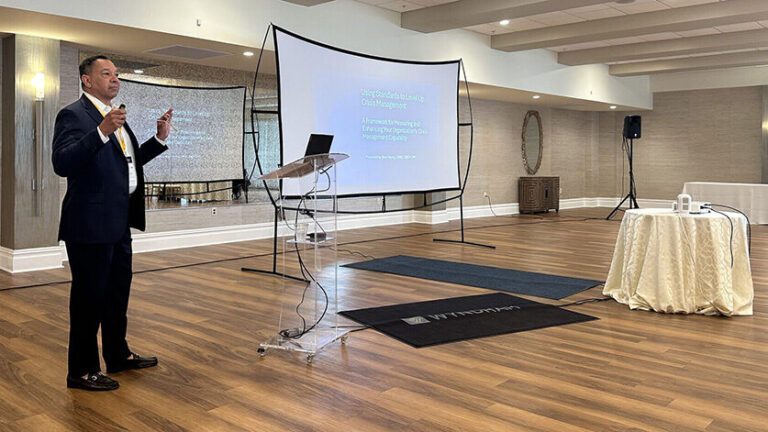
Training is the fire drill before the blaze. It’s where theory becomes action, where plans become lived experience, and where teams learn to trust each other under pressure. That’s why the International Crisis Management Conference (ICMC) puts training front and center.
At ICMC, you’ll hear from practitioners who’ve been in the hot seat, join workshops that simulate real-world crises, and connect with peers who face the same challenges you do. It’s not about abstract theory, it’s about walking away with tools, techniques, and confidence you can apply the moment you’re back at your desk.
If operational resilience training is on your agenda—and it should be—there’s no better place to sharpen your skills and expand your network than ICMC. Explore our upcoming sessions, join the conversation, and invest in the one thing no crisis can take from you: readiness.
¹ PwC, Global Crisis and Resilience Survey 2023




Add your first comment to this post